Mayor Sanchez POLL. Bulukin? Palayain? Mga kaDDS, ano po ang say ninyo tungkol sa pagpapalaya sa MANGGAGAHASANG MAMAMATAY taong si Sanchez na nahulihan pa ng MARIJUANA at SHABU habang nakakulong? Attendance po tayo. Nasaan kayo? Taga saan kayo?


The death of environment warrior Gina Lopez has elicited praise and admiration for her passion in her fight to protect Mother Nature. Even Congressional personalities, both Senators and Representatives, sing to the high heavens about her stint as Department of Environment and Natural Resources Secretary, when she held big business by the balls, enforcing laws, policies, rules and regulations that would have meant the closure of erring, and there were many, mining and logging companies. Few , if any, among the lawmakers mentioned how the Commission of Appointments, which they manned dealt the death blow to her short, but spectacular, stint in public office.
If she had not been infirm, she could have run for senator in the recently concluded midterm elections and may have won and taken her seat in the Senate as a nationally elected official whose stay in office would not be subject to the whims of an appointing power or the Commission on Appointments. Then 2022 could have propelled her to higher office or the next President could appoint her back the the DENR (again to face the Commission of Appointments).
Alas, fate had to intervene to snuff the life of a dedicated and effective former Secretary when there are hundreds of corrupt officials who should have departed the world in her place.
So it is business as usual for the companies that denude our forests, flatten our mountains and poison our air and water. The drive for corporate profit continues at the expense of our future but there would no longer be a Gina Lopez to speak for us so we might as well get used to the idea that we have to fend off for ourselves.


Pinangalanan ni Quezon City Mayor Joy si dating Mayor Bistek na dati niyang kaalyado na sumuporta daw sa kalaban sa nakalipas na halalan. Sa kathang isp ni Mayora, sinasabotahe daw siya ng mga loyalista kay Herbert na nananatiling nasa City Hall.
MANILA, Philippines — Unpaid obligations of Philippine Health Insurance Corp. (PhilHealth) have financially weakened many private hospitals in the country, including Chinese General Hospital and Medical Center (CGHMC), according to Dr. James Dy, president of the private hospital.
In a letter to PhilHealth branch manager Henry Almanon on July 17, Dy said the state insurance firm owed CGHMC P204.6 million for the medical services it provided to PhilHealth members from April to June.
In a text message to the Inquirer on Monday, PhilHealth acting president and chief executive officer Ricardo Morales declined to comment, saying he had yet to see Dy’s letter.
Due, demandable
Of the total unpaid amount, P61.7 million was already “due and demandable” since the hospital had already complied with all the documentary requirements imposed by PhilHealth, according to Dy.
“[Since] the medical services on this claim had long been served, it is grossly unfair for the state insurance system to put the financial burden of public health care on private hospital institutions, and then leave us hanging for months and years on end just to get paid,” he said.
Senate probe
He submitted a copy of his letter to Sen. Bong Go, chair of the Senate health committee, and Sen. Richard Gordon, chair of the blue ribbon committee, who will jointly head on Wednesday a legislative inquiry into irregularities in PhilHealth.
In a dialogue in May, Dy said PhilHealth officials had promised CGHMC to settle the debts within 10 days, but they failed to keep their word.
PhilHealth, a government-owned and -controlled corporation mandated to provide social health insurance to Filipinos, has been under the microscope after the Inquirer published a series of investigative reports on the alleged massive corruption involving its officials and unscrupulous owners of private health facilities.
In a privilege speech on July 29, Sen. Panfilo Lacson claimed PhilHealth had already lost as much as P154 billion to overpayments and other fraudulent schemes.
Lacson said the state insurance company was financially ill as it suffered a net operating loss of P29.1 billion from 2013 to 2017 due to fund mismanagement and corruption.
In his letter, Dy pointed out that the delay in PhilHealth’s payment “negatively impacts the provision of quality health care” for Filipinos.
Citing hospital records, he said PhilHealth paid a measly P14.9 million to CGHMC for the medical services it rendered from June 14 to July 17.
But this amount, he added, was just 7 percent of PhilHealth’s total unpaid obligations to the hospital.
He said PhilHealth’s latest filing system necessitated the hospital to have another program and “reprocess” all the forms it had submitted for insurance claims worth P142.9 million.
Moreover, he said, PhilHealth had sent back collection forms to CGHMC “based on unsubstantiated reasons,” such as the unreadability of statement of accounts.
Incompatible
This problem was caused by the “incompatibility” in the electronic processing systems of PhilHealth and its technology provider, Eurolink, according to Dy.
“Any incompatibility on both systems that results in poor readability is beyond the control of the hospital, and hence, should not be blamed on the hospital,” he said.
“Simply put, the hospital should not suffer the adverse consequence of poor data integration from Eurolink to PhilHealth,” he added.
Dy said the passage of the UHC law, which required a budget of P257 billion for the first year of its implementation, warranted the removal of “organizational bureaucracy” in PhilHealth to ensure the timely payment of hospital dues.
He said PhilHealth’s critical role in attaining the law’s goals “will never be realized unless industry-wide collection is improved dramatically.”
“The confidence of the various sectors in PhilHealth’s credibility to successfully implement the provisions of this new law rests on your capability to finally clear away PhilHealth’s transactional backlog,” Dy reminded Almanon. —With a report from Jovic Yee

Adverse audit observations noted by the Commission on Audit (COA) seemed to support President Rodrigo Duterte’s misgivings about the Land Bank of the Philippines (LBP) which he conveyed in his State of the Nation Address on Monday.
In the 2018 annual audit report (AAR) recently released by COA, auditors noted that LBP’s credit card receivables account amounting to P401.92 million as of December 31, 2019.
In the executive summary of the audit report, COA also drew attention to the Financial Statement indicating that the LBP’s Fair Value Through Other Comprehensive Income/Available-for-sale investments account included undelivered 3,366,800 Meralco shares.
“Likewise corresponding cash dividends earned amounting to P403.481 million and P358.446 million as at December 31, 2018 and 2017, respectively and property dividends of 9,488,394 shares of stock in Rockwell Land Corporation were still unpaid to LBP,” the audit agency said.
In his SONA, Duterte scolded the LBP, alleging that it had been focusing too much on commercial operations. As such, the President said the government bank had failed to help the farmers and fisherfolk it was meant to primarily help.
“I will give you until the end of July to give me a plan or else I will ask Congress to reconfigure you or whatnot… if there is no viable plan for the farmer then it is all commercial transaction, I plan to abolish it,” said the chief executive.
The AAR revealed that audit suspensions and disallowances have reached P2,871,717,704.84 that included P2.81 billion in unauthorized disbursement involving Priority Development Assistance Fund of congressional members and the Development Acceleration Program of the Aquino administration.
“The other suspensions and disallowances are payments of benefits and allowances of LBP Board of Directors, officers and employees which were not in accordance with existing laws, rules and regulations,” the audit report stated.
State auditors also took notice of the P164.469 million in past due loans under the Livelihood Loan System and the LBP Mobile Loan Saver that remained uncollected “due to non-compliance with the remedial actions for past due accounts.”
The LBP was warned that this exposed the bank to “possible credit losses.”
“Non-recovery of the loan could also affect the financial performance and deprives the bank of additional funds and the income that could be generated therefrom, had it been timely collected,” COA said.
On its credit card operations, COA disclosed that there have been delays in the recording of payments of Mastercard and VISA amounting to P50.043 million.
This and other operational lapses, the audit agency said, affected the faithful representation of the Credit Card Receivables amounting to P401.929 million as of December 31, 2018 which could not be ascertained due to the General Ledger and Subsidiary Ledger balances aggregating P734.971 million.
In response to the audit finding, the LBP management admitted delays in the reconciliation reports, saying that this was due to the “migration of VISA credit card to MasterCarBusiness Integrated and its subsequent upgrade to Mastercard Integrated.”
***************************
The President threatened to shut down the bank’s operations. “You are supposed to finance agricultural enterprises and endeavors. Bakit wala? (Why is there none?) Why can’t you just buy a few wagons or whatever? Go to the countryside and ask the people if there are cooperatives, tulungan ninyo (help them) to form one,” he said in his speech.
Since its creation in 1963, Landbank has emerged as one of the biggest banks in the country. Here are some fast facts about the government bank.
1. Landbank’s creation and primary function
Landbank was formed under Republic Act 3844 or the Agricultural Land Reform Code in August 1963. The main function of the bank is to be the financing agency for the government’s acquisition of agricultural estates for division and resale to small landholders, as well as the purchase of the land-holding by the agricultural lessee.
2. It was eventually granted universal banking powers in 1973
Ten years after its creation, Landbank was granted universal or expanded commercial banking powers through Presidential Decree 251 to remedy the bank’s “deficient and inadequate” capitalization and organization structure. Former president Ferdinand Marcos cited the bank’s failure to meet the requirements of the agrarian reform program, so he included granting short-, medium- and long-term loans to agricultural, industrial, home-building projects, and other productive enterprises to Landbank’s powers.
In 1977, the bank underwent a major reorganization and formed 3 main sectors: agrarian, banking, and operations. Today, Landbank’s role is not limited to the provision of credit assistance to farmers and fisherfolk. It is also an implementing agency of the Comprehensive Agrarian Reform Program, as well as an official depository of government funds.
As of July 2019, Landbank has a total of 401 branches and 2,046 automated teller machines nationwide.
3. Landbank now belongs to the top 10 universal/commercial banks in the Philippines
In Duterte’s 4th SONA, in jest, he called Landbank the “number one” commercial bank in the Philippines. “You know, you are called Land Bank but you are now the number one commercial bank in the Philippines. What the heck is happening to you?” Duterte said a little over the one-hour-and-20-minute mark into his speech.
While Landbank is not the leading bank in the Philippines, based on 5 metrics, it is included in the Bangko Sentral ng Pilipinas’ (BSP) top 10 rankings of universal/commercial banks as of March 2019: assets, stockholder’s equity, deposits, loans, and return on equity.
Landbank is the 3rd biggest universal/commercial bank with total assets of P1.9 trillion. Its stockholder’s equity – the amount of assets the bank has minus its liabilities – stands at P136.5 billion, while its total deposits as of March 2019 reached P1.7 trillion – second to the Sy family-owned BDO Unibank’s P2.3 trillion. In the same period, Landbank also had P850.8 billion in its total loans and receivables portfolio.
4. The Duterte administration stopped the Landbank-Development Bank of the Philippines merger
Former president Benigno “Noynoy” Aquino III signed and approved the proposed merger of the two government banks in February 2016 through Executive Order No. 198. Under this EO, Landbank was supposed to be the surviving entity between the two banks.
EO 198’s goal was to increase Landbank’s capital stock to P200 billion from P25 billion and to strengthen the financial capabilities of both banks while avoiding unnecessary overlaps of their respective functions.
However, the new administration stopped the merger in September 2016, led by the Governance Commission for Government-Owned and -Controlled Corporations (GCG). Finance Secretary Carlos Dominguez III pointed out that the two banks serve different functions: Landbank for the agriculture sector, and DBP, for industry.
5. Landbank’s loan portfolio and its compliance with the Agri-Agra Law
Under the Republic Act 10000 or the Agri-Agra Reform Credit Act, banks are mandated to allot 25% of their loan portfolios for agriculture and fisheries – 10% for agrarian reform projects and 15% for agriculture.
Landbank’s First Vice President for Corporate Affairs Catherine Rowena Villanueva said the combined loans extended to the agriculture sector and the its mandated sector, which includes agrarian reform beneficiaries and their associations as well as small farmers, reached 27.45% of the bank’s total loan portfolio of P799.64 billion as of June 30, 2019.
Data from BSP show that the compliance of universal and commercial banks are way below the minimum amount required, with total compliance for agrarian reform credit only reaching 1.01% of its minimum required amount as of end-March 2019, and only 13.27% for agricultural credit.
But Villanueva said Landbank remains to be the biggest lender to the sector. “While growth of the agriculture sector remained stagnant for the past 10 years, averaging only 1.11%, Landbank’s loans to the sector continued to increase at an average of 10.94%,” she added.
Economist and former socioeconomic planning secretary Cielito Habito argued that Duterte’s scolding is “misplaced” since Landbank is expected to be profitable just like other commercial banks and is still subject to the same rules imposed by the BSP.
“Like it or not, lending in an agricultural sector dominated by smallholders is always risky business anywhere, and even more so in a calamity-prone country like ours. That’s why commercial banks prefer to pay the fine for not complying with the Agri-Agra law, rather than lend the mandated amounts of loans to small farmers and agrarian reform beneficiaries,” he wrote.
Landbank also reported in the 1st quarter of 2019 that its loans to the agricultural sector grew 12% year-on-year to P13 billion. This covers 128,496 small farmers and fishermen.
6. Landbank’s actions to Duterte’s threats
Duterte has been urging Landbank to focus more on the farmers and fishermen even before his 4th SONA. He earlier threatened to look into the finances of the bank in 2018.
A day after President Duterte threatened to abolish Landbank, the bank said it is submitting a detailed report of its plans and programs for farmers. The bank also turned over 354,783 hectares of land to the Department of Agrarian Reform on July 25.
Prior to this, the bank had committed in December 2016 to loan P115 billion to small farmers and fishermen by 2022 – which triples the P37.9 billion recorded that year. – Rappler.com

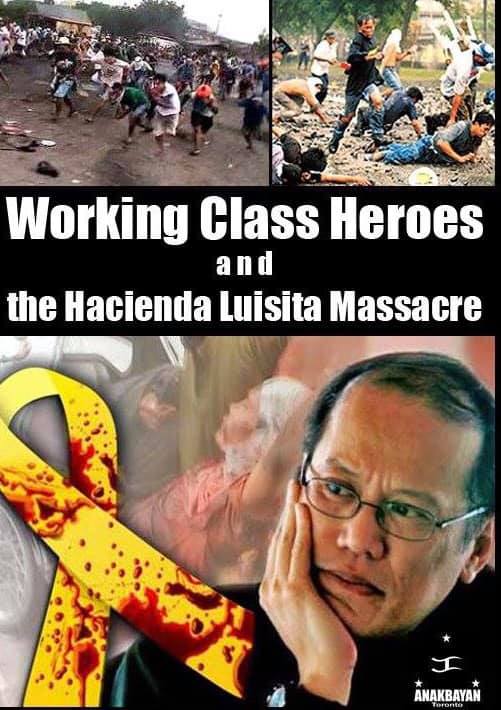
P-Noy, as he would later be called, concocted a fantastic tale to justify the killings in his family-owned Hacienda Luisita. In his figment of his imagination, which he stated in a speech at the House of Representatives, he blurted a dumb hypothesis – that snipers BEHIND the picket line (meaning fronting the law enforcers), shot the rallying farmers and supporters from the BACK. Since there was a huge media coverage of the event, lots of still and video photos were/are available for review and all of the shooting came from the state security forces. Aquino’s invented snipers could not shoot the protesters in the back since the victims were RUNNING AWAY from the lawmen. No credible investigating body from either side of the feud has dignified the then future President’s tale that only a certified LANDLORD can think off. Noynoying Aquino took pains to drive his point that while condemnation of the massacre was in order, he emphasized that the party pointed to, the law enforcers, was MISDIRECTED (meaning he believed his imaginary snipers did the shooting). Fifteen years after the fact, the grand theory of Noynoy Aquino is generally consigned to oblivion and gets dusted off during the massacre anniversaries or, more often than not, seldom mentioned at all.
*****************************
Aquino Privilege Speech Hacienda Luisita Massacre
November 16, 2004
Mr. Speaker, the Hacienda Luisita and a factory called Central Azucarera de Tarlac are both located in the Second District of Tarlac which I represent. A lot of people who worked in both firms are residents of my district although there are four other barangays that are also situated within the hacienda and are part of the Third District of Tarlac. Ever since all of these issues, the idea of retrenchment and so and so forth have occurred due to, according to the company, the distress of the company, we have sought ways and means to alleviate the problems of all our constituents to include not only the workers but also that of the companies that are located in our district, in the interest of serving all our constituents best. We would just like to manifest for the information of all our colleagues, a few days ago, perhaps, I am not sure of the exact date right now Mr. Speaker, but about two days ago if I am not mistaken, the PNP in response to an order, assuming jurisdiction issued by the Department of Labor and Employment, tried to effect a dispersal of a strike which in the opinion of the company and which is subject again of proceedings within the DOLE now was an illegal strike.
May I explain. According to the company, no strike vote was called for which is a prerequisite for calling a strike. Most of the workers of the union about 400 out of 736 have decided to take a stand against the so-called strike and have reentered the factory using various means like climbing the factory walls just to gain entry and evade the blockade by what was perceived as just a faction of their union who is not responding to their wishes. This is significant that in this latest labor dispute that the company is facing, most of the workers have decided to take a position which they believe is in their interest and their future interest. Now, consistent to that Mr. Speaker, a few days ago, I believe two days ago, if I am not mistaken, I am sorry, we have really been exhausted trying to resolve or come up with a peaceful solution to the problem, the PNP exercising maximum tolerance, decided to forego the use of tear gas, water cannons, and so many other devices open to them and just attempted to push out those blocking the entry and exit points of the factory premises, consistent with the deputization order coming from the Department of Labor and Employment.
As a result of this, those who were manning the picket lines, which up to this point, is being contested as not being made up primarily of workers of the hacienda, they were met by a hail of stones and various other implements resulting into the injury of these police officers.
The Regional Director, in his report to me, stated that they decided not to pursue with the dispersal operations given the premise that perhaps this can be settled with the very minimum violence was erroneous, and therefore, pursuing it would have resulted in further injuries.
To that extent, Mr. Speaker, today, new dispersal operations have been conducted. We, together with our colleagues from Bayan Muna and Anakpawis, condemned the violence that happened. But we are questioning as to whether or not the condemnation is directed at the right party.
The reports that I have been getting this whole afternoon, one of them stated that when the dispersal commenced this afternoon, elements of the PNP and the AFP were subjected to sniper fire allegedly coming from a barangay adjacent to the company premises. The results re, that of these men, the reports that we have gotten are: There are at least 10 who are injured on the part of the so-called picketing strikers—ten wounded, three have died and at least another three form the ranks of the government personnel, namely the PNP and the AFP, have also been injured.
Mr. Speaker, may I ask just one basic question to wind up this personal and collective privilege. We all here are lawmakers. Our main function is to make laws. I understand from our lawyers that I have consulted, for instance the blocking of factory premises is not allowable under the Labor Code. We have been asked to allow this continued blockade, which is already the source of numerous complaints from various small planters who are waiting to reap the proceeds form their panting of sugarcane and to which they have already been experiencing intense economic difficulties, compounded by the poor prices of sugar. We also are asking whether or not the rights of those who have chosen to adhere to the rule of law should be ignored, when it is convenient for certain factions to ignore the law. Is that the position we are taking, Mr. Speaker?
Also, consistent with the challenge that they issued to this Representation to join in the investigation of the so-called SDO (stock distribution option) arrangement, in compliance with the CARP law, we have co-authored, together with them and are awaiting the committee meetings of the Agrarian Reform Committee of the House.
In effect, Mr. Speaker, what I am trying to say simply put, is that as lawmakers I think we are the first who should be championing the adherence completely and faithfully to all the laws governing us instead of mainly complying when it suits us. This is a true situation that has escalated, and I will not name names at this point in time, Mr. Speaker, until I have gathered all of the evidence.
The primary responsibility for my district should lie with me, Mr. Speaker. And, unfortunately, there were certain quarters, who I will identify at a future date, who decided to exploit the situation, resulting in injuries and deaths to a lot of my constituents, which is believe calls for justice and I will champion that in due time, Mr. Speaker.
Thank you and good afternoon.


LANDMARK RULING OVER TORRENS TITLES
x x x x x x x x x x x x x x x x x x x x x x x x x x x x x x x x x x x x
Ayala Land loses in Las Piñas land dispute
By JOMAR CANLAS, The Manila Times
October 2, 2017
x x x x x x x x x x x x x x x x x x x x x x x x x x x x x x x x x x
SC voids Ayala Land’s ownership of prime lot in Las Piñas
The property developer says it has filed a motion for reconsideration following the Supreme Court ruling that it is not the rightful owner of a 6.8-hectare lot in Ayala Southvale
October 2, 2017
MANILA, Philippines – Property giant Ayala Land Incorporated (ALI) lost control of a 6.8-hectare lot of prime land in Las Piñas City following a ruling by the Supreme Court (SC).
The SC, in a ruling issued last July but made public on Monday, October 2, denied ALI’s right to ownership of the lot and declared petitioners Yu Hwa Ping and Mary Gaw, as well as the heirs of Andres Diaz and Josefa Mia, as the rightful owners.
The 6.8-hectare lot, which houses the Southlinks Golf Club and materials depot, is located inside ALI’s Ayala Southvale Village in Las Piñas City.
Ayala Corporation, ALI’s parent firm, acquired the property from Goldenrod Incorporated and Pesala in 1988. ALI gained ownership of the land after its merger with Las Piñas Ventures Incorporated in 1992.
The SC made its decision based on invalid surveys done to register the land nearly 90 years ago.
In coming to the decision, the SC ruled that, “When a land registration decree is marred by severe irregularity that discredits the integrity of the Torrens system, the Court will not think twice in striking down such illegal title in order to protect the public against unscrupulous and illicit land ownership.”
In the Torrens system, transfer of land ownership is done by transfer of land registration rather than by deeds.
Motion for reconsideration
In a disclosure to the Philippine Stock Exchange (PSE) on Monday, ALI said it filed a motion for reconsideration on September 28.
The primary grounds for the appeal, said ALI, include the following:
“ALI’s titles can be traced back to Original Certificates of Titles (OCT) that were issued decades prior to the OCTs from which the claimants’ title came from. In particular, ALI’s titles are traced back to OCTs issued in 1950 and 1958 whereas the claimants’ titles are traced back to an OCT issued in 1970.”
“Claimants’ predecessors opposed ALI’s application and participated, but lost, in the original land registration proceedings which led to the issuance of decrees for registration in favor of ALI’s predecessors. Thus, claimants are barred by prescription, laches and res judicata.”
ALI purchased the properties after an examination of its derivative titles which on their face do not indicate any defect or flaw, thereby making ALI an innocent purchaser for value.
ALI also pointed out that “it had conducted an investigation of titles to the properties and had no notice of any title or claim that was superior to the titles purchased by ALI.”
As such, the property developer believes that “its titles are superior to the claims of these adverse claimants.”
ALI said it does not expect the legal battle to have “any material effect on [its] business, operations, and financial conditions,” since the lot is less than 1% of its total land bank of 9,852 hectares. – Rappler.com
XXXXXXXXXXXXXXXXXXXXXXXXXXXXXXXXXXXXX
By: Marlon Ramos – Reporter Philippine Daily Inquirer
October 02, 2017
Property giant Ayala Land Inc. (ALI) has lost ownership of a prime 6.8-hectare lot in Las Piñas City, which it had converted into a golf course and materials depot.
In a 30-page ruling, the Supreme Court (SC) nullified ALI’s right to possess the property as it declared petitioners Yu Hwa Ping and Mary Gaw, and the heirs of Andres Diaz and Josefa Mia, as the rightful owners of the disputed land.
The landmark decision, penned by then SC Justice Jose Mendoza, recognized that irregularities could accompany the registration of land and must be nullified to protect the public and the Torrens system.
The high court’s Second Division voided ALI’s land titles for the property, which was located inside Ayala Southvale Subdivision, after concluding that the land surveys made to register it nearly 90 years ago were invalid.
“The court cannot close its eyes to the blatant defects on the surveys upon which the original titles of ALI were derived simply because its titles were registered,” the tribunal said in its July 26 decision, which was made public only recently.
Torrens system
“When a land registration decree is marred by severe irregularity that discredits the integrity of the Torrens system, the court will not think twice in striking down such illegal title in order to protect the public against unscrupulous and illicit land ownership,” it stressed.
In voiding ALI’s right to possess the land, the court reiterated that registration was “not a mode of acquiring ownership” of a property and that securing a certificate of title “merely confirms or records title already existing and vested.”
“The indefeasibility of a Torrens title should not be used as a means to perpetrate fraud against the rightful owner of real property. Good faith must concur with registration because, otherwise, registration would be an exercise in futility,” it ruled.
Ayala Corp. acquired the property from Goldenrod Inc. and Pesala in 1988.
Four years later, ALI became its new owners after its merger with Las Piñas Ventures Inc.
The controversial piece of real estate is inside Ayala Southvale in Las Pinas City, which ALI converted into the Southlinks golf course and a materials depot.
Lawful owners
But the petitioners, who bought the land in 1993, separately questioned ALI’s ownership claims in 1995 and 1996 before the Regional Trial Courts of Pasig and Las Piñas, respectively, which eventually recognized them as lawful owners.
ALI then brought the case to the Court of Appeals, which ruled in its favor in 2006 after filing a second motion for reconsideration.
Other justices who concurred with Mendoza were Associate Justices Antonio Carpio, Diosdado Peralta, Marvic Leonen and Samuel Martires.

The Office of President Duterte thru the Office of Executive Secretary Medialdea, on July 5, 2019, endorsed for evaluation and appropriate action the complaints of several concerned employees of the Novaliches District Hospital, managed by the local government unit of Quezon City.
Fifteen COS (contract of service) employees and seven consultants were unceremoniously informed on July 1, 2019 that their contracts would no longer be renewed. July 1 was the first day of office of senators, representatives, governors, vice-governors, provincial board members, mayors, vice mayors and councilors. In Quezon City, Mayor Joy Belmonte assumed office and her appointed Novaliches District Hospital Medical Director, with the name of a certain Doctor Aldana, also on his first day to return to that position, promptly issued walking papers to the twenty-two. Said memorandum of the Medical Director was in direct conflict to the pronouncement of the new mayor that no contract of service would be terminated.
Analysis: The Office of the Mayor of Quezon City proclaimed that it has the sole prerogative of hiring and firing as far as city employees are concerned. If that is the case, then on whose authority did the Novaliches District Hospital Medical Director issue the termination memorandum? A grave abuse of authority/discretion case against the Medical Director is a legal option available to the aggrieved parties. Aside from that, how come it has taken weeks to start an investigation to the detriment of hospital patients and services? In the same span of time the City of Manila has progressed by leaps and bounds under the able leadership of new Mayor Isko Moreno. On the other hand, Quezon City is being left behind on the garbage clearing and road obstruction (illegally parked vehicles and vendors taking over sidewalks and streets) fronts.
Mayor Joy Belmonte is rationalizing the illegal vendors occupying the sidewalks of NIA Road instead of ordering the clearing of the sidewalks so that people can use them. Take note that there is also garbage in the middle of the street.

*********************
But promises not to block programs of the national government
Gabriel Pabico-Lalu / Inquirer
July 29, 2019

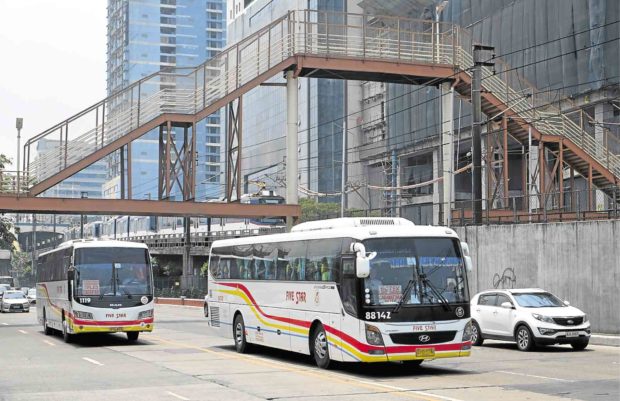
Buses from provinces in Northern and Southern Luzon will soon be banned from plying Edsa as their terminals along Metro Manila’s busiest road will be closed to ease traffic congestion. (Photo by NIÑO JESUS ORBETA / Philippine Daily Inquirer)
MANILA, Philippines – Quezon City Mayor Joy Belmonte has been considering various opinions in fixing her city’s road obstruction problems to arrive at a “win-win” situation between motorists and street vendors.
Belmonte bared this at a meeting of Metro Manila mayors at the Department of the Interior and Local Government (DILG) office on Monday in reference to reports that vendors removed along NIA Road in Diliman had returned.
“Actually, I had already talked to those who returned to NIA Road,” Belmonte, speaking in Filipino, told reporters on the sidelines of the meeting. “They have places to live in, but they go out to make a living. So we’ll see. NIA Road is wide enough as it is.”
“The problem is they’ unsightly. They’re an eyesore,” she added. “So what I plan for them is to give them proper stalls, even if I have to give them myself, so they could sell in the area because I don’t think they are an obstruction given the wideness of the street.”
Last Thursday, July 25, Interior Secretary Eduardo Año ordered Metro Manila mayors to clear their streets of obstructions within 60 days, starting today, Monday, July 29.
Año issued the order on the instruction of President Rodrigo Duterte, who tasked the DILG with penalizing mayors who refuse to clear roads that cause heavy traffic.
But even with her own programs at hand, Belmonte said she would cooperate with the President and gave the assurance that she would not prevent the national government and other agencies from implementing their own programs.

Quezon City Mayor Joy Belmonte. (File photo by RYAN LEAGOGO / INQUIRER.net)
“But if the MMDA [Metropolitan Manila Development Authority] would tell me that I could not do one thing, we’d look for another solution,” she said. “The people are open to dialogue. The problem is that we have judged them already, that they would not understand. But when I talked to them, they said they understood.”
Belmonte also said that this formula would also apply to the impending ban of provincial buses along Epifanio de los Santos Avenue (Edsa).
Several provincial bus terminals are located on both sides of EDSA, particularly in Cubao, near Quezon Avenue and Kamuning Avenue.
“As I said when I was given the notice, I would have all the terminals shut down. I can do that,” Belmonte said. “Well, there are some options that were presented — such as the point-to-point buses, which they said they would increase.”
“So I would like to continue dialoguing with the people so we could come up with sustainable solutions to the problems,” she added. “I’m a very participatory leader. But at the end of the day, I don’t want to be a hindrance to the programs of our President.”
She said that she would use this formula — even if she would draw flak from the media or other stakeholders.
“We will do this with the police… But you know, I wanted to try to do it first without the police,” she said. “We will do whatever we can. For me, the important thing is planning.”
“So to those criticizing me: You want me to act fast. But I’m a planner. I’m a strategist. The plan has to in order. We have to take baby steps every week to accomplish it in 60 days.”
/atm